The Crisis Magazine
Like blackface minstrelsy, right-wing attempts to vilify Obama reveal the racism beneath the greasepaint.
At the height of the health care debate in the fall, former President Jimmy Carter dared to utter what countless Blacks were thinking: The rhetoric of 9/12 Tea Party protesters crossed the line of partisan bickering and, in the tradition of homegrown White supremacy, was racist at its core. Carter’s charge, like our sentiment, was virtually silenced by conservatives, moderates and even some liberals, and by the president himself. All of Carter’s critics agreed that the backlash against President Obama wasn’t about race. The contrast between their public denials and our collective gut instinct raises one of the most crucial questions for...
Originally published on newsone.com
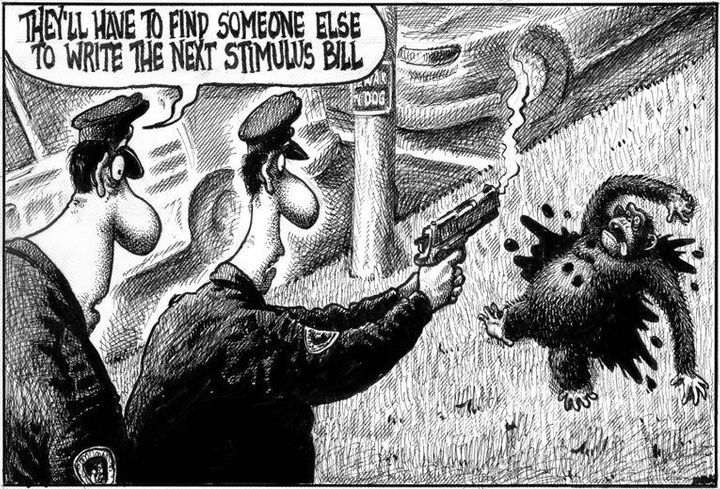
Yesterday, as I prepared for the kick-off to the national discussion tour focused on the theme “Is America Really Post-Racial?” which will convene in ten US cities this spring, I received emails from around the country commenting on The New York Post cartoon that depicts a chimpanzee being shot by two white police officers. The cartoon prominently displays one of the officers saying, “They’ll have to find someone else to write the next stimulus bill.”
The commentary comes on the heels of the historic election of Barack Obama as the nation’s first Black president. During the campaign, Obama had been likened to the famed children’s book protagonist and monkey, “Curious George,” and numerous Americans openly expressing their...
Originally published on newsone.com
Yesterday, as I prepared for the kick-off to the national discussion tour focused on the theme “Is America Really Post-Racial?” which will convene in ten US cities this spring, I received emails from around the country commenting on The New York Post cartoon that depicts a chimpanzee being shot by two white police officers. The cartoon prominently displays one of the officers saying, “They’ll have to find someone else to write the next stimulus bill.”
The commentary comes on the heels of the historic election of Barack Obama as the nation’s first Black president. During the campaign, Obama had been likened to the...
Originally Published in Newsday
When Don Imus put his foot in his mouth on the air last
week with a dirty and derogatory reference to young black women, he was
articulating a message that had been clearly voiced by Michael Richards, Rush
Limbaugh and countless others long before him. Ditto the white law students at
the University of Connecticut who donned big booties and blackface this year on
Martin Luther King Day, as well as the rash of undergraduates across the
country, from Michigan to...
The Village Voice
Armed with messages of Black political resistance, Black pride, and opposition to militarization and corporatization, designed in part to counter the commercial hip-hop party-and-bullshit madness dumbing down the nation's youth, hip-hop's lyrical descendants of the "fight the power" golden era today are booking concerts in record numbers—far beyond anything imaginable by their predecessors. Problem is, they can hardly find a Black face in the audience.
As the Coup (Pick a Bigger Gun), Zion-I (True and Livin'), and the Perceptionists (Black Dialogue) get set for a wave of touring to promote their new CDs this summer, the audience that will be looking back at them unmasks one of the most...
Black Book magazine
Jay-Z likes to tell the story of the radio station that invited him in for an interview. He arrives, sits down at the mic and can't help wondering why he's surrounded by bottles of Cristal. "What's that for?" he asks. "You," the radio host responds. "Come on Be for real, man, like what—did you think I was going to be popping Cristal at ten o-clock in the morning?"
Pose a surface question to Jay-Z about his seeming obsession with all things bourgeois from the private jets to Benzes, designer clothing and beyond that have served as the backdrop for much of his highly successful rap career and expect a defensive response.
" A lot of my records, a lot of things I do I just really paint a picture, you know. And, sometimes I'm just...

On a bright, Indian summer day in September 1997, after weeks of tension between her and the father of Afrocentricity, Molefi Asante, Joyce Ann Joyce, who had just been appointed to replace Asante as chair of Temple University's African American studies department, stumbled upon what she thought was an opportunity to keep a bitter feud from erupting into full-scale war. About 10 yards ahead of her, alone in the hallway of Gladfelter Hall, was the Afrocentrist par excellence. "Finally," she recalls thinking to herself, "maybe we can talk." With the murmur of...
Originally published with Hakim Hasan on newsone.com
The overwhelming social transformation rendered in the 1950s and 1960s, the Civil Rights Movement is a milestone in American history of such magnitude that it assumes a mythological quality, almost willing us to define the future in its image. But our own post-civil rights movement era requires us to reframe what “civil rights” actually means. Changes in the way many Americans have come to think of the role of government, the overwhelming influence of corporate media, the disproportionate influence of America’s super rich, and today’s activists’ focus on human rights and social justice rather than simply civil rights make the question of civil rights leaders almost passé. Old standards of measures of civil rights...